Well, it's time to wrap things up. What have I learned throughout this personal project? What do I still have left to learn? In a lot of ways, I think I've just scratched the surface of this particular topic, and there's a lot more out there to address.
This project went a different direction than I expected it to when I started out. I originally was planning on making some major changes to my diet. Instead, what I ended up with was a project more about learning what the impact was of the things I was already eating than it was about making radical changes to my eating habits. I ended up making some small changes to my diet, substituting more organic products for mass-produced food, and buying more local food than I ever had. In the process, I tried to analyze what impact both my old and new eating patterns were having on myself, my community, and the planet.
I've learned...
* That our food system is horrible for the planet, and not very good for people, either. It uses way too much land to grow food for both us and the animals we eat, is loaded with artificial crap, and emits a whole bunch of greenhouse gases into the air through both its production and in transporting our food to our plates.
* That industrial meat is probably the biggest culprit in our food system's destruction of the planet, and that we eat way too much of it. Even staying away from red meat can only have limited impacts if you replace it with other types of meat, like chicken or fish.
* That there are some little things that I can do to improve the situation, like by buying meat and produce that is locally farmed and learning to make more things from scratch rather than buying packaged food.
* That you always have to read the fine print, whether you're looking at labels on products or buying food from the farmer's market. What you think you end up getting is not always what you think. So read labels, talk to your local farmers about the practices they use to raise/grow their food, and make up your own mind about the products you're buying. Only buy those things that address the issues you care about or satisfy the goal you hope to achieve.
* That perhaps the biggest impact local food can have is on the local economy, which in turn effects the environmental impact your food choices have. Buying local food means local farmers have more money to expand their operations and hire more help, which in turn helps them expand their operations and sell more local food, and so on and so forth. In the process, more of your food comes from environmentally-friendly farmers (hopefully...see above about talking to farmers about their practices) and travels a shorter distance to get to your plate, which reduces your food's ecological footprint.
Still, there are many more things that I can and should be doing to improve upon my food choices and reduce my food's environmental impacts. To wit:
* Eat less meat. Despite the fact that I've mostly cut beef (the biggest contributor to our food system's huge ecological footprint) out, I've mostly replaced it with chicken. Though a chicken has less impact than a cow, the fact that we as Americans eat so damn many chickens eliminates a big portion of the gains one could achieve by switching from beef to chicken. So the bottom line is that less meat of any kind is good. I'm not saying I'm going to go fully vegetarian, because I just don't think I'm ready for that. But I need to be more of a vegetarian than I currently am. One way to do that might be to...
* Join a CSA. Community-supported agriculture delivers fresh fruit and vegetables from local farmers to your doorstep (okay, most of the time you have to go pick it up yourself instead of having it delivered) each week. There are several of them around Bloomington, and CSA's are popping up all over the country. And if I did join a CSA, it might force me to...
* Get even more creative about making more of my own food. There's still so much I feel like I can be doing differently that I have not yet done. Joining a CSA might cause me to make more vegetarian dishes. Again, it's not like I'd give up meat entirely, but making a vegetarian dish and shunning meat for a night certainly wouldn't kill me. Besides, meat is expensive, no matter where you buy it.
* Keep learning about the issues. There's plenty out there to read about our food system and how to make it more sustainable. I read parts of Food, Inc., which revealed how industrialized food has become in the name. But there's a lot more writing that discusses people's journeys through the food system and their attempts to change it. I'm hoping to delve into some of those writings in the near future.
So I guess that's it. The project has been good, but it's only been the tip of iceberg as far as learning about food and changing my diet. I'm looking forward to making some more of those changes in the coming months.
Have a great rest of the semester and enjoy your holidays.
Monday, December 12, 2011

Friday, December 9, 2011
Personal Project: A Look at My Food-Spending Patterns
Several weeks ago, I decided to do a two-week experiment to see how I was spending my money on food. I wanted to do this as a metric of what kind of impact I'm having on myself, the environment, and the local economy. This little experiment was done from Nov. 4 through Nov. 18. Throughout this two week period, I recorded all the money I spent on food and where I spent it. I also kept the receipts from grocery stores so I could see how much money I was spending on organic products as opposed to conventional products, as well as local versus chain stores and restaurants.
Here's a quick breakdown of my spending pattern in this two-week period (they're in percentages only because I don't really feel like advertising exactly how much I actually spend on food):
Where I spent my money:
Percent at chain grocery stores -- 40.39%
Percent at Bloomingfoods -- 30.11%
Percent at farmer's market -- 20.24%
Percent at local restaurants -- 5.46%
Percent at chain restaurants -- 3.80%
OVERALL percent local -- 55.81%
OVERALL percent chain -- 44.19%
Percent of total spending on organic food: 38.95%
Percent of grocery store spending on organic food: 55.25%
So that's a brief glimpse into how I spent my food money during the experimental period. An important thing to note is what these percentages looked like before I started this project. Basically, all of my grocery shopping was at Kroger, with zero percent at the farmer's market or local stores. I probably ate at local restaurants more than chain places, though. That's something I've been trying to do for a few years. I used to travel for work a lot, and when I could, I would find a local place to eat because I liked having something different than what I'm used to at home. So from this standpoint, I feel like I've made some progress, since I've made a concerted attempt to shop locally.
In looking at my spending on organic food, I would guess the percentages above are higher than they were before I started this project, but I'm not certain. I know I would buy organic apples and oranges, but that was about it. Since starting this, whenever I buy produce, I try to make it organic unless I can't find that particular item in organic form. One caveat to the organic spending percentages is the money I spent at the farmer's market (explored more below). I'm not sure how much of that was organic and how much wasn't. I can say a lot of it was spent on organic, free-range meat that I blogged about previously, though.
So what have been the impacts of the things that I've done? There are three areas in which I feel like I've had some impact: my personal health, the health of the environment, and the health of the local economy. Now obviously it's hard to quantify exactly what impacts I've had on any of these areas, so I'm going to have to address the topic generally.
Personal health: I blogged previously about the effects of organic food on health. To recap, while there is some evidence that organics are better for you than conventional food, it's mixed and very difficult to determine with precision. One aspect that I didn't address, however, was the health impact of the local food that I've been purchasing. According to an e-mail conversation I had with the woman who runs Bloomington's farmer's market, everyone who sells there must be from Indiana. Now, Indiana's a big place, and I think the definition of "local" that the farmer's market is using (to them, all of Indiana is local) is a bit more extensive from the way many people define "local" (which is within 100 miles). That being said, since we live roughly in the middle of the state, anything purchased at the farmer's market is still pretty local. I mention this because local food tends to have health benefits: Since it travels much fewer miles to get to your plate, it has generally not lost much of its nutritional value, which makes local food a bit healthier for you than non-local food. So from that standpoint, I would say that I've improved my personal health at least a little bit.
Environmental health: This is kind of complicated. The reason it's complicated is because I had a few misconceptions about the food I was buying. My assumption was that everything I bought at the farmer's market and Bloomingfoods was organic. Turns out that may not necessarily be the case. Officially, the farmer's market does not require food sold there to be certified organic. In fact, according to the woman who runs the market, only a few of the vendors have their produce organically certified. That being said, I spoke with one of the farmers there, and he gave me a glimpse into his methods. He does not use pesticides or fertilizers; instead, he uses coverage crops and composted manure from his livestock as fertilizer, and has to get rid of pests himself. His cows are allowed to graze in the pasture, and as an added bonus, fertilize the soil in the process. He also fallows part of his land each year to increase its fertility. So while his practices do not include fertilizer, irradiation, or pesticides, he can't technically call his food "organic" because it isn't certified. In addition, I have two neighbors who work at Bloomingfoods. I spoke with them about Bloomingfoods food, and their indication was that not all the food there is either local or organic. The big advantage to Bloomingfoods is that it is locally-owned (it is a cooperative), so the money spent there mostly stays local.
The lesson is to pay attention to labels and talk to the farmers you are buying from at the farmer's market. You can find out more information about their growing methods, etc., and make your own determination about whether their product meets your desires. I bring this up because it makes it more difficult to determine what the environmental impact of my food purchases has been. It would be much easier if I could just say, "Oh, it's all organic," and have that be good enough. But technically, it wasn't. That being said, the fact that bought a good amount of local and/or certified organic food says I did something right, even if it might not have been as much as I originally hoped.
Local economic health: This is where my efforts may have made the most impact. We hear a lot about how buying local helps the economy. I found a couple of infographics here and here that detail how local spending helps the local economy. The Union of Concerned Scientists (UCS) notes that modest investments in farmer's markets around the country could result in thousands of new jobs. This is because local farmers tend to buy locally and hire more local people. They can do this by skipping the middle man and selling their product directly to their customers at farmer's markets instead of through wholesalers. Since Bloomingfoods is a locally-owned coop, many of the same benefits also accrue when you shop there. So because I've been spending more of my money there and at the farmer's market, I like to think I'm making at least a bit of difference in my local economy.
The end result: It seems like I may have had a bigger effect on the local economy than I have on my health or on the environment. That's tough to say for sure, though. I like to think I'm doing something right on all fronts, but I think I might have to make bigger changes over a longer timeframe before really drawing any conclusions.
Here's a quick breakdown of my spending pattern in this two-week period (they're in percentages only because I don't really feel like advertising exactly how much I actually spend on food):
Where I spent my money:
Percent at chain grocery stores -- 40.39%
Percent at Bloomingfoods -- 30.11%
Percent at farmer's market -- 20.24%
Percent at local restaurants -- 5.46%
Percent at chain restaurants -- 3.80%
OVERALL percent local -- 55.81%
OVERALL percent chain -- 44.19%
Percent of total spending on organic food: 38.95%
Percent of grocery store spending on organic food: 55.25%
So that's a brief glimpse into how I spent my food money during the experimental period. An important thing to note is what these percentages looked like before I started this project. Basically, all of my grocery shopping was at Kroger, with zero percent at the farmer's market or local stores. I probably ate at local restaurants more than chain places, though. That's something I've been trying to do for a few years. I used to travel for work a lot, and when I could, I would find a local place to eat because I liked having something different than what I'm used to at home. So from this standpoint, I feel like I've made some progress, since I've made a concerted attempt to shop locally.
In looking at my spending on organic food, I would guess the percentages above are higher than they were before I started this project, but I'm not certain. I know I would buy organic apples and oranges, but that was about it. Since starting this, whenever I buy produce, I try to make it organic unless I can't find that particular item in organic form. One caveat to the organic spending percentages is the money I spent at the farmer's market (explored more below). I'm not sure how much of that was organic and how much wasn't. I can say a lot of it was spent on organic, free-range meat that I blogged about previously, though.
So what have been the impacts of the things that I've done? There are three areas in which I feel like I've had some impact: my personal health, the health of the environment, and the health of the local economy. Now obviously it's hard to quantify exactly what impacts I've had on any of these areas, so I'm going to have to address the topic generally.
Personal health: I blogged previously about the effects of organic food on health. To recap, while there is some evidence that organics are better for you than conventional food, it's mixed and very difficult to determine with precision. One aspect that I didn't address, however, was the health impact of the local food that I've been purchasing. According to an e-mail conversation I had with the woman who runs Bloomington's farmer's market, everyone who sells there must be from Indiana. Now, Indiana's a big place, and I think the definition of "local" that the farmer's market is using (to them, all of Indiana is local) is a bit more extensive from the way many people define "local" (which is within 100 miles). That being said, since we live roughly in the middle of the state, anything purchased at the farmer's market is still pretty local. I mention this because local food tends to have health benefits: Since it travels much fewer miles to get to your plate, it has generally not lost much of its nutritional value, which makes local food a bit healthier for you than non-local food. So from that standpoint, I would say that I've improved my personal health at least a little bit.
Environmental health: This is kind of complicated. The reason it's complicated is because I had a few misconceptions about the food I was buying. My assumption was that everything I bought at the farmer's market and Bloomingfoods was organic. Turns out that may not necessarily be the case. Officially, the farmer's market does not require food sold there to be certified organic. In fact, according to the woman who runs the market, only a few of the vendors have their produce organically certified. That being said, I spoke with one of the farmers there, and he gave me a glimpse into his methods. He does not use pesticides or fertilizers; instead, he uses coverage crops and composted manure from his livestock as fertilizer, and has to get rid of pests himself. His cows are allowed to graze in the pasture, and as an added bonus, fertilize the soil in the process. He also fallows part of his land each year to increase its fertility. So while his practices do not include fertilizer, irradiation, or pesticides, he can't technically call his food "organic" because it isn't certified. In addition, I have two neighbors who work at Bloomingfoods. I spoke with them about Bloomingfoods food, and their indication was that not all the food there is either local or organic. The big advantage to Bloomingfoods is that it is locally-owned (it is a cooperative), so the money spent there mostly stays local.
The lesson is to pay attention to labels and talk to the farmers you are buying from at the farmer's market. You can find out more information about their growing methods, etc., and make your own determination about whether their product meets your desires. I bring this up because it makes it more difficult to determine what the environmental impact of my food purchases has been. It would be much easier if I could just say, "Oh, it's all organic," and have that be good enough. But technically, it wasn't. That being said, the fact that bought a good amount of local and/or certified organic food says I did something right, even if it might not have been as much as I originally hoped.
Local economic health: This is where my efforts may have made the most impact. We hear a lot about how buying local helps the economy. I found a couple of infographics here and here that detail how local spending helps the local economy. The Union of Concerned Scientists (UCS) notes that modest investments in farmer's markets around the country could result in thousands of new jobs. This is because local farmers tend to buy locally and hire more local people. They can do this by skipping the middle man and selling their product directly to their customers at farmer's markets instead of through wholesalers. Since Bloomingfoods is a locally-owned coop, many of the same benefits also accrue when you shop there. So because I've been spending more of my money there and at the farmer's market, I like to think I'm making at least a bit of difference in my local economy.
The end result: It seems like I may have had a bigger effect on the local economy than I have on my health or on the environment. That's tough to say for sure, though. I like to think I'm doing something right on all fronts, but I think I might have to make bigger changes over a longer timeframe before really drawing any conclusions.
Personal Project: How Healthy is Organic Food?
As I've been going through this project, I have to ask myself whether eating more organic food has made me any healthier. Realistically, given that this has only been going on since the beginning of the semester, I've probably not improved my health a substantial amount. I'm guessing it takes a lot longer than a few months to make a lasting impact. Nevertheless, let's pretend it's five years in the future and I've been eating all organic food for the whole time. Is this fictional, futuristic me any more healthy than the old me?
Then answer, it seems, is maybe, maybe not. There's a lot of conflicting evidence out there on the health benefits of organic food. It seems pretty clear that organic food is better for the environment, but whether it is better for an actual person's health is open to debate. This fact sheet put together in 2004 by the British government, for instance, notes that organic produce may actually have more of certain micronutrients (such as calcium, iron, and vitamin C). The question is, however, are the differences really that dramatic? WebMD says no. It says that the differences are negligible, and research is still ongoing. This is largely what I found in some literature reviews that specifically looked at the issue of the health benefits of eating organic food.
Okay, so what about pesticides and other bad stuff that is sprayed on our food? We've known at least since Rachel Carson wrote Silent Spring that such substances are bad news. The problem is, we don't know for sure how much harm is caused people if they spend a lifetime consuming very small amounts of pesticides and other chemicals. One study I read concluded that, by and large, our produce contains levels of pesticides well below what the government deems is safe. Presumably, this means that eating conventional food would not result in a significantly higher risk of getting cancer, for instance, than one would have from eating organic food. There are some foods that take up pesticides at a higher rate than others. Apples are one of them, which makes me happy I've been buying all organic apples lately (because I eat a lot of them).
Meat may be a bit of a different story. Here the issue is antibiotics and hormones. Meat produced conventionally is filled with hormones and antibiotics. Our use of hormones in meat, however, is beginning to be connected to antibiotic resistance, which is when strains of bacteria that are not affected by antibiotics start crowding out the strains that are affected. The more we feed antibiotics to the animals we eat, the more we risk the bacteria we're trying to kill becoming resistant to our antibiotics. We're seeing more and more outbreaks of things like E. coli lately, and it seems that they can usually be traced back to meat. If you extend this idea out in the long term, conventional meat is definitely less healthy than organic meat that is not given hormones or antibiotics.
As the evidence I've seen shows, the issue is pretty complicated. To some extent, it seems that the choice to eat organic as opposed to conventional food is as much a lifestyle choice of what's considered acceptable risks than anything. So far, there doesn't seem to be a consensus that significant evidence exists in favor of organics on this issue, but there is some evidence that organic food is marginally better for you then conventional. Whether it's worth the additional money to you to buy it...well, that's up to you, I guess.
Then answer, it seems, is maybe, maybe not. There's a lot of conflicting evidence out there on the health benefits of organic food. It seems pretty clear that organic food is better for the environment, but whether it is better for an actual person's health is open to debate. This fact sheet put together in 2004 by the British government, for instance, notes that organic produce may actually have more of certain micronutrients (such as calcium, iron, and vitamin C). The question is, however, are the differences really that dramatic? WebMD says no. It says that the differences are negligible, and research is still ongoing. This is largely what I found in some literature reviews that specifically looked at the issue of the health benefits of eating organic food.
Okay, so what about pesticides and other bad stuff that is sprayed on our food? We've known at least since Rachel Carson wrote Silent Spring that such substances are bad news. The problem is, we don't know for sure how much harm is caused people if they spend a lifetime consuming very small amounts of pesticides and other chemicals. One study I read concluded that, by and large, our produce contains levels of pesticides well below what the government deems is safe. Presumably, this means that eating conventional food would not result in a significantly higher risk of getting cancer, for instance, than one would have from eating organic food. There are some foods that take up pesticides at a higher rate than others. Apples are one of them, which makes me happy I've been buying all organic apples lately (because I eat a lot of them).
Meat may be a bit of a different story. Here the issue is antibiotics and hormones. Meat produced conventionally is filled with hormones and antibiotics. Our use of hormones in meat, however, is beginning to be connected to antibiotic resistance, which is when strains of bacteria that are not affected by antibiotics start crowding out the strains that are affected. The more we feed antibiotics to the animals we eat, the more we risk the bacteria we're trying to kill becoming resistant to our antibiotics. We're seeing more and more outbreaks of things like E. coli lately, and it seems that they can usually be traced back to meat. If you extend this idea out in the long term, conventional meat is definitely less healthy than organic meat that is not given hormones or antibiotics.
As the evidence I've seen shows, the issue is pretty complicated. To some extent, it seems that the choice to eat organic as opposed to conventional food is as much a lifestyle choice of what's considered acceptable risks than anything. So far, there doesn't seem to be a consensus that significant evidence exists in favor of organics on this issue, but there is some evidence that organic food is marginally better for you then conventional. Whether it's worth the additional money to you to buy it...well, that's up to you, I guess.
Personal Project: Seasonal Food
Something that I decided to take a look at this week is seasonal food. I haven't really given much thought to seasonality as I've gone through this project. However, recently I started looking into what the benefits of seasonal food are and how to find seasonal food.
One of the biggest benefits of seasonal food is its nutritional value. One thing I did not realize is that our food loses its nutritional value the longer it goes before it gets eaten. Here's how it works:
Take produce for instance. Our produce gets nutrients (vitamins and minerals) from the soil. Once it gets picked from the tree or plant, obviously it is no longer receiving nutrients, so it's at its most nutritious right after picking. This makes sense, but the part I didn't realize is that these nutrients degrade over time. Once they're exposed to light and oxygen, these nutrients start to break down and leach out of the produce. So if you don't eat that piece of produce as soon as it's picked, you're going to get fewer nutrients. The problem is, most of us aren't farmers, so we can't eat our produce as soon as it's picked. Therefore, we're not getting the full effects.
There are several ways that we lose nutrients from our food. One is by picking food before it is really ripe. I learned that much produce is picked before it's fully ripe because it has to travel so far to get to its final destination. If we pick food before it is ripe, it does not acquire the full nutritional value that it could have, so once the nutrients start to degrade, they're doing so from a lower baseline nutrient level. Much produce is processed (read: irradiated) as soon as possible to lock in the maximum amount of nutrients possible, but even this process sometimes causes produce to lose some nutrients. Canning and freezing have pretty much the same effect.
Another problem with nutrients is the distance the piece of produce has to travel to get to its final destination. I've heard it estimated that, on average, our food travels 1,500 miles to get to our plate. Imagine the amount of nutrients that are lost in this process.
The best solution I've been able to find to this problem is to buy seasonal food. The advantage to buying seasonal food is that you know you're getting food at its freshest and most nutritious. (As an added bonus, the fresher and more nutritious food is, the better it tastes!) This has a lot to do with the fact that seasonal food is often also locally grown (because what's in season depends a great deal on geography). So you're getting several benefits at once if you're eating seasonal food: eating healthy, supporting local farmers, and cutting down on the miles that your food travels to get to your plate. That cuts down on the greenhouse gases your contributing to the atmosphere.
Thus far, I haven't made a huge effort to specifically eat seasonal food. Or at least, not intentionally. Given that I've been shopping much more at the farmer's market, I think almost by default I've been able to buy some seasonal food. But there's plenty of things that are grown locally on a seasonal basis that I haven't really tried: things like pumpkin, squash, snap peas, and eggplant are in season during the fall, but I haven't really tried any of them. This is mostly because I don't know how to do much with any of them.
So this might be something to try in the future. Tasty, seasonal, local food would create variety and be an opportunity to try something new while helping the local economy and eating healthy food.
A few links:
Here's a list of Indiana produce and meat and when it's in season.
Here's another one that's even more comprehensive.
You can find seasonal guides for any state here.
Here, here, and here are articles about the benefits of eating local, seasonal food.
And finally, the top ten ways to eat local, seasonal food all year can be found here.
One of the biggest benefits of seasonal food is its nutritional value. One thing I did not realize is that our food loses its nutritional value the longer it goes before it gets eaten. Here's how it works:
Take produce for instance. Our produce gets nutrients (vitamins and minerals) from the soil. Once it gets picked from the tree or plant, obviously it is no longer receiving nutrients, so it's at its most nutritious right after picking. This makes sense, but the part I didn't realize is that these nutrients degrade over time. Once they're exposed to light and oxygen, these nutrients start to break down and leach out of the produce. So if you don't eat that piece of produce as soon as it's picked, you're going to get fewer nutrients. The problem is, most of us aren't farmers, so we can't eat our produce as soon as it's picked. Therefore, we're not getting the full effects.
There are several ways that we lose nutrients from our food. One is by picking food before it is really ripe. I learned that much produce is picked before it's fully ripe because it has to travel so far to get to its final destination. If we pick food before it is ripe, it does not acquire the full nutritional value that it could have, so once the nutrients start to degrade, they're doing so from a lower baseline nutrient level. Much produce is processed (read: irradiated) as soon as possible to lock in the maximum amount of nutrients possible, but even this process sometimes causes produce to lose some nutrients. Canning and freezing have pretty much the same effect.
Another problem with nutrients is the distance the piece of produce has to travel to get to its final destination. I've heard it estimated that, on average, our food travels 1,500 miles to get to our plate. Imagine the amount of nutrients that are lost in this process.
The best solution I've been able to find to this problem is to buy seasonal food. The advantage to buying seasonal food is that you know you're getting food at its freshest and most nutritious. (As an added bonus, the fresher and more nutritious food is, the better it tastes!) This has a lot to do with the fact that seasonal food is often also locally grown (because what's in season depends a great deal on geography). So you're getting several benefits at once if you're eating seasonal food: eating healthy, supporting local farmers, and cutting down on the miles that your food travels to get to your plate. That cuts down on the greenhouse gases your contributing to the atmosphere.
Thus far, I haven't made a huge effort to specifically eat seasonal food. Or at least, not intentionally. Given that I've been shopping much more at the farmer's market, I think almost by default I've been able to buy some seasonal food. But there's plenty of things that are grown locally on a seasonal basis that I haven't really tried: things like pumpkin, squash, snap peas, and eggplant are in season during the fall, but I haven't really tried any of them. This is mostly because I don't know how to do much with any of them.
So this might be something to try in the future. Tasty, seasonal, local food would create variety and be an opportunity to try something new while helping the local economy and eating healthy food.
A few links:
Here's a list of Indiana produce and meat and when it's in season.
Here's another one that's even more comprehensive.
You can find seasonal guides for any state here.
Here, here, and here are articles about the benefits of eating local, seasonal food.
And finally, the top ten ways to eat local, seasonal food all year can be found here.
Monday, December 5, 2011
Sustainability Events: Wasteland
For my last sustainability event, I'd like to talk about a movie I saw earlier this year at the IU Cinema: "Wasteland". I know I wrote a brief blurb about it back in September, but I want to expand upon the film now.
Brief description of the film: It follows artist Vik Muniz, who grew up in Brazil but lives in New York, as he returns to Brazil to the largest garbage dump in the world: Jardim Gramacho, located just outside Rio de Janeiro. There are a group of people who live there, referred to as "pickers," whose job it is to go through all the trash that ends up there from all over Rio and find things that can be recycled. Muniz's goal is to create works of art out of the garbage and the people. He takes photos of the pickers posing with the garbage they deal with every day, then hires them to help him create even bigger works of art. They come back with him to a studio in Rio, where they arrange huge piles of trash to resemble the photographs Vik has taken, and then he takes photos of THAT. It's kind of hard to describe, so just take a look at this:

See all the garbage laid out around the guy in the bathtub? Muniz took a photo of this. That's the final product. This particular picture he sold at auction and gave all the proceeds to the pickers for them to build a library and some other stuff. You can also see the official website here and the official trailer here.
Clearly garbage plays a big role in this documentary. It's pretty appalling to see all of the trash from one of the world's biggest cities all piled up in one place. We have talked about trash a lot in this class. The bottom line with trash is that we don't think about it after throwing it away. No one really cares where it goes, just as long as it isn't stinking up our apartment anymore. Out of sight, out of mind. Well, now you see where it all ends up: one humongous pile of trash that just sits there doing nothing. And a lot of it can be recycled and reused.
More important are the parallels the film draws between the trash and the people who live and work among it. At one point, I think someone refers to the pickers as "human garbage," and in some ways, that's not far from the truth. These are poor folks who don't have any other way to make a living, so they sort through other people's trash looking for recyclable material. But no one cares about them, because no one sees them or has any interest in the trash they work with. Once again, out of sight, out of mind. So there's a distinct parallel drawn between how we treat our trash and how we treat people like the pickers.
One question I think the film asks (or at least that came to my mind) is, what would happen if we started actually thinking about both the pickers and the garbage they attend to? One of our readings a few weeks ago discussed treating people as human beings instead of as means of production to be done away with when no longer useful. I think the same point applies here. What if we both stopped throwing away so much stuff, AND started investing in education, health care, housing infrastructure, and creating decent jobs that paid living wages? Then we could kill two birds with one stone: we would no longer have such massive piles of garbage like in Jardim Gramacho, and we could harness the human power that the people in Jardim Gramacho possessed. Throughout the film, we see these people struggle to support themselves and obtain basic needs like education and housing. What if we actually provided such things for everyone? We might no longer have quite as much garbage, human or otherwise.
When you get right down to it, this is what sustainability is about: creating a world in which people actually want to live, and then giving them the capability to live within it, and do so productively and with respect. I think that's what "Wasteland" was trying to get at: the potential to transform our lives and the lives of many more people in the process.
Brief description of the film: It follows artist Vik Muniz, who grew up in Brazil but lives in New York, as he returns to Brazil to the largest garbage dump in the world: Jardim Gramacho, located just outside Rio de Janeiro. There are a group of people who live there, referred to as "pickers," whose job it is to go through all the trash that ends up there from all over Rio and find things that can be recycled. Muniz's goal is to create works of art out of the garbage and the people. He takes photos of the pickers posing with the garbage they deal with every day, then hires them to help him create even bigger works of art. They come back with him to a studio in Rio, where they arrange huge piles of trash to resemble the photographs Vik has taken, and then he takes photos of THAT. It's kind of hard to describe, so just take a look at this:

See all the garbage laid out around the guy in the bathtub? Muniz took a photo of this. That's the final product. This particular picture he sold at auction and gave all the proceeds to the pickers for them to build a library and some other stuff. You can also see the official website here and the official trailer here.
Clearly garbage plays a big role in this documentary. It's pretty appalling to see all of the trash from one of the world's biggest cities all piled up in one place. We have talked about trash a lot in this class. The bottom line with trash is that we don't think about it after throwing it away. No one really cares where it goes, just as long as it isn't stinking up our apartment anymore. Out of sight, out of mind. Well, now you see where it all ends up: one humongous pile of trash that just sits there doing nothing. And a lot of it can be recycled and reused.
More important are the parallels the film draws between the trash and the people who live and work among it. At one point, I think someone refers to the pickers as "human garbage," and in some ways, that's not far from the truth. These are poor folks who don't have any other way to make a living, so they sort through other people's trash looking for recyclable material. But no one cares about them, because no one sees them or has any interest in the trash they work with. Once again, out of sight, out of mind. So there's a distinct parallel drawn between how we treat our trash and how we treat people like the pickers.
One question I think the film asks (or at least that came to my mind) is, what would happen if we started actually thinking about both the pickers and the garbage they attend to? One of our readings a few weeks ago discussed treating people as human beings instead of as means of production to be done away with when no longer useful. I think the same point applies here. What if we both stopped throwing away so much stuff, AND started investing in education, health care, housing infrastructure, and creating decent jobs that paid living wages? Then we could kill two birds with one stone: we would no longer have such massive piles of garbage like in Jardim Gramacho, and we could harness the human power that the people in Jardim Gramacho possessed. Throughout the film, we see these people struggle to support themselves and obtain basic needs like education and housing. What if we actually provided such things for everyone? We might no longer have quite as much garbage, human or otherwise.
When you get right down to it, this is what sustainability is about: creating a world in which people actually want to live, and then giving them the capability to live within it, and do so productively and with respect. I think that's what "Wasteland" was trying to get at: the potential to transform our lives and the lives of many more people in the process.
Sustainability Events: Lotus Festival
As you are probably aware, Bloomington holds the Lotus World Music & Arts Festival every September. This is an event that brings together musical acts and artists from all over the world for three days in...the middle of Indiana? Huh? Why not New York or L.A. or San Francisco or somewhere like that? I'm not real sure exactly. I couldn't find out. What I found is that it's named after a local musician named Quinton Lotus Dickey, and it's been going on for eighteen years now. It seems like a rollicking good time every year in downtown B'town.

I did not attend last year, my first year in Bloomington. Mostly I was deterred by the price. Being a new grad student and not knowing how much money I had available, it seemed a little extravagant to drop $25 or whatever on a ticket. This year I found my way around that little problem. I heard they let in free one night if you volunteer for a few hours. Boom. Problem solved.
So I ended up volunteering to help set up on Friday morning, the first day of the festival. (Technically, I think it started the night before, but there was only one venue that night, so most stuff wasn't set up.) It was basically a lot of putting tents together, blocking off streets, setting up tables, hooking up some lights, etc., etc. Some heavy lifting and moving things around, generally. It seemed like a pretty well-run show, because most of the people in charge had been doing this for a while and knew the ropes. Those of us who hadn't volunteered before mostly just followed orders, which was perfectly fine with me. And I got a bright orange T-shirt out of the deal.
So after volunteering to set up Friday morning/early afternoon, I got my free ticket for Friday night. I chose that night mostly because I wanted to see the person who you might consider the headliner of the night: Abigail Washburn. She performs a combination of folksy-rootsy-Americana music and Chinese music, which I find to be an interesting combination. I definitely enjoyed seeing her play to close the night, but the highlight for me came earlier in the night.
I had originally planned on seeing an Irish/Celtic act in the second group of performances. But as I was sitting in the church where they were supposed to play and looking at the schedule, I suddenly realized that I had a hankering for some Swedish swing/hip-hop instead. Yeah, you read that right. It sounded like quite an intriguing mesh of styles. So on the spur of the moment, I left the church and headed for the big tent where this band Movits! was playing.
They did not disappoint. In case you missed it, check out this video. You, too, will not be disappointed. I loved the energy they brought, and the mix of hip hop, dance, and swing was definitely an interesting mix. I gather they are starting to blow up all over the world. Even Stephen Colbert had them on his show a while back. I highly recommend checking them out if you can.
So what does this have to do with sustainability? It has to do with social capital, and to some extent with cultural capital. Way back in chapter one of the Roseland book, we talked about social capital as the way that relationships are formed, norms are passed on, and networks of citizens are put to work. In a nutshell, it's a community-building event. I like to think that by volunteering and attending Lotus, I helped bring Bloomington together a bit. As discussed in chapter one of Roseland, social capital can enhance the effectiveness of other types of capital, but it's hard to build and probably even harder to maintain. Fortunately Bloomington is a pretty arts-friendly community, so something like this is effective as a social capital-building event. The relationships that are built through events such as Lotus can lead to other things, such as other community events, business opportunities, and friendships that help knit a community's fabric together, which helps make a community a more livable place. Perhaps most importantly, after working together on something like Lotus, citizens may be more likely to work together on bigger issues, like resolving poverty issues or improving transit systems.
From a cultural standpoint, Lotus is kind of unique in that it presents world music and not just American styles of music. Not only does the international focus introduce more people to one aspect of another culture, but it also reinforces Bloomington's niche as a city with a strong internationally diverse identity. We've all been to Bloomington's ethnic restaurants and had friends who are international students. Lotus is just one more aspect of how Bloomington builds it's diverse cultural identity.
I would argue that big events like Lotus are more important for the social fabric in a small city like Bloomington than they are in a bigger city (Indy, for instance). That's because in a small city you're more likely to interact with people you worked on Lotus with on a regular basis, so there's more opportunities to exploit the relationships built at Lotus in other venues. From that standpoint, I'm glad that I both attended and was able to help stage this year's Lotus event.

I did not attend last year, my first year in Bloomington. Mostly I was deterred by the price. Being a new grad student and not knowing how much money I had available, it seemed a little extravagant to drop $25 or whatever on a ticket. This year I found my way around that little problem. I heard they let in free one night if you volunteer for a few hours. Boom. Problem solved.
So I ended up volunteering to help set up on Friday morning, the first day of the festival. (Technically, I think it started the night before, but there was only one venue that night, so most stuff wasn't set up.) It was basically a lot of putting tents together, blocking off streets, setting up tables, hooking up some lights, etc., etc. Some heavy lifting and moving things around, generally. It seemed like a pretty well-run show, because most of the people in charge had been doing this for a while and knew the ropes. Those of us who hadn't volunteered before mostly just followed orders, which was perfectly fine with me. And I got a bright orange T-shirt out of the deal.
So after volunteering to set up Friday morning/early afternoon, I got my free ticket for Friday night. I chose that night mostly because I wanted to see the person who you might consider the headliner of the night: Abigail Washburn. She performs a combination of folksy-rootsy-Americana music and Chinese music, which I find to be an interesting combination. I definitely enjoyed seeing her play to close the night, but the highlight for me came earlier in the night.
I had originally planned on seeing an Irish/Celtic act in the second group of performances. But as I was sitting in the church where they were supposed to play and looking at the schedule, I suddenly realized that I had a hankering for some Swedish swing/hip-hop instead. Yeah, you read that right. It sounded like quite an intriguing mesh of styles. So on the spur of the moment, I left the church and headed for the big tent where this band Movits! was playing.
They did not disappoint. In case you missed it, check out this video. You, too, will not be disappointed. I loved the energy they brought, and the mix of hip hop, dance, and swing was definitely an interesting mix. I gather they are starting to blow up all over the world. Even Stephen Colbert had them on his show a while back. I highly recommend checking them out if you can.
So what does this have to do with sustainability? It has to do with social capital, and to some extent with cultural capital. Way back in chapter one of the Roseland book, we talked about social capital as the way that relationships are formed, norms are passed on, and networks of citizens are put to work. In a nutshell, it's a community-building event. I like to think that by volunteering and attending Lotus, I helped bring Bloomington together a bit. As discussed in chapter one of Roseland, social capital can enhance the effectiveness of other types of capital, but it's hard to build and probably even harder to maintain. Fortunately Bloomington is a pretty arts-friendly community, so something like this is effective as a social capital-building event. The relationships that are built through events such as Lotus can lead to other things, such as other community events, business opportunities, and friendships that help knit a community's fabric together, which helps make a community a more livable place. Perhaps most importantly, after working together on something like Lotus, citizens may be more likely to work together on bigger issues, like resolving poverty issues or improving transit systems.
From a cultural standpoint, Lotus is kind of unique in that it presents world music and not just American styles of music. Not only does the international focus introduce more people to one aspect of another culture, but it also reinforces Bloomington's niche as a city with a strong internationally diverse identity. We've all been to Bloomington's ethnic restaurants and had friends who are international students. Lotus is just one more aspect of how Bloomington builds it's diverse cultural identity.
I would argue that big events like Lotus are more important for the social fabric in a small city like Bloomington than they are in a bigger city (Indy, for instance). That's because in a small city you're more likely to interact with people you worked on Lotus with on a regular basis, so there's more opportunities to exploit the relationships built at Lotus in other venues. From that standpoint, I'm glad that I both attended and was able to help stage this year's Lotus event.
Saturday, December 3, 2011
Personal Project Update: The Evils of Soda...and Maybe Something Slightly Less Evil?
So let's talk about soda, something I drink a decent amount of. Not a huge amount...but enough. Say, three to four sodas a week. Okay, when I actually say it that sounds like kind of a lot. But I've known people who drink a lot more, so I guess that makes me feel a little better. My soda of choice is Dr. Pepper. It's the 23 flavors. I mean, really, how can it get any better??? (Twenty-four flavors would just be overkill.)

Anyway, we hear lots of stories about how soda is bad for you. So I decided to go out and look for why and how soda might be bad for me. The first thing I did was take a look at the ingredient list on a bottle of Dr. Pepper. First on the list: water. Everyone likes water. Good. Second on the list: high fructose corn syrup. Ah, crap. I've hard of this stuff. Supposedly it's bad for you. So I went looking to find out what it is and why it's bad for me.
Check out this link from The Learning Channel that discusses high fructose corn syrup (HFCS). In a nutshell, the problem with HFCS and many other artificial sweeteners is that they're the epitome of empty calories. What's more, sweeteners actually make us hungrier. I guess something that has basically no nutritional value AND makes me want to consume even more calories is probably not the best thing to be consuming. That's probably why so many studies tend to link soda to obesity. As the TLC article states, we're getting more of our calories from sweeteners like HFCS, and we tend to not count calories from drinks as part of our total daily calorie intake. So the more soda we drink, the more calories we consume, and the more food we want to consume. A vicious cycle to be sure. The problem is, these sweeteners are in practically everything we eat these days, which just makes things worse.
There is also an environmental aspect to HFCS. As the name implies, HFCS is made of corn. We grow an awful lot of corn in the U.S.: 72.7 million acres of it, according to the EPA. I mentioned in my previous post about the movie "Food Inc." that corn farmers receive huge subsidies for their product, which means they are going to grow as much of it as possible. Generally, that means more land used up for corn production, and more pesticides and other crap sprayed on it to make it grow. All of this contributes to global warming, erosion and loss of soil productivity. So in other words, it's basically bad all around.
So what is a soda drinker to do? Well, there are alternatives out there that don't use these artificial sweeteners. This week, I decided to give one of them a try.

Blue Sky Organic Cola is something I found at Bloomingfoods and decided to give a try. It contains no HFCS or other artificial sweeteners. Instead, it is made with organic cane sugar. The taste is pretty good; they don't seem to have a Dr. Pepper equivalent, but they do have a regular cola flavor, and it's not bad. The problem is, it's still soda, and it's still sugar. Still not the best of things to be drinking, I guess: there's 40 grams of sugar included in a can. I don't know for sure, but that sounds like a lot.
So I guess the moral is that moderation is best when it comes to soda, even if it's an organic soda with no artificial sweeteners. Can I handle moderation? That's another story.
Anyway, we hear lots of stories about how soda is bad for you. So I decided to go out and look for why and how soda might be bad for me. The first thing I did was take a look at the ingredient list on a bottle of Dr. Pepper. First on the list: water. Everyone likes water. Good. Second on the list: high fructose corn syrup. Ah, crap. I've hard of this stuff. Supposedly it's bad for you. So I went looking to find out what it is and why it's bad for me.
Check out this link from The Learning Channel that discusses high fructose corn syrup (HFCS). In a nutshell, the problem with HFCS and many other artificial sweeteners is that they're the epitome of empty calories. What's more, sweeteners actually make us hungrier. I guess something that has basically no nutritional value AND makes me want to consume even more calories is probably not the best thing to be consuming. That's probably why so many studies tend to link soda to obesity. As the TLC article states, we're getting more of our calories from sweeteners like HFCS, and we tend to not count calories from drinks as part of our total daily calorie intake. So the more soda we drink, the more calories we consume, and the more food we want to consume. A vicious cycle to be sure. The problem is, these sweeteners are in practically everything we eat these days, which just makes things worse.
There is also an environmental aspect to HFCS. As the name implies, HFCS is made of corn. We grow an awful lot of corn in the U.S.: 72.7 million acres of it, according to the EPA. I mentioned in my previous post about the movie "Food Inc." that corn farmers receive huge subsidies for their product, which means they are going to grow as much of it as possible. Generally, that means more land used up for corn production, and more pesticides and other crap sprayed on it to make it grow. All of this contributes to global warming, erosion and loss of soil productivity. So in other words, it's basically bad all around.
So what is a soda drinker to do? Well, there are alternatives out there that don't use these artificial sweeteners. This week, I decided to give one of them a try.
Blue Sky Organic Cola is something I found at Bloomingfoods and decided to give a try. It contains no HFCS or other artificial sweeteners. Instead, it is made with organic cane sugar. The taste is pretty good; they don't seem to have a Dr. Pepper equivalent, but they do have a regular cola flavor, and it's not bad. The problem is, it's still soda, and it's still sugar. Still not the best of things to be drinking, I guess: there's 40 grams of sugar included in a can. I don't know for sure, but that sounds like a lot.
So I guess the moral is that moderation is best when it comes to soda, even if it's an organic soda with no artificial sweeteners. Can I handle moderation? That's another story.
Thursday, December 1, 2011
Sustainability Events: The Day After Thanksgiving (Whatever You Wanna Call It)
Ah, the day after Thanksgiving. A day when everyone is too fat to do much of anything...except go shopping at the big mega-mall. Or at your local boutiques. Or don't go shopping at all. That's what this post is about.
The day after Thanksgiving has become known as "Black Friday" for major retailers. It's probably the one day that stores look forward to the most, because they know that the first unofficial shopping day of the Christmas season will sit the tone for the rest of the season and put many retailers "in the black" for the year. As such, they tend to pull out all the stops to make it as profitable a day as possible. You've seen the pictures and news stories about how stores open at some ungodly hour to let in the people who have been lining up since an even earlier ungodly hour to get in and take advantage of ginormous deals. Just in case you haven't, here's a news story and a picture for you:

Inevitably, you hear a story about the craziness that occurs in the mad rush for savings. This year was no different. There was a story about a woman who used pepper spray on her fellow shoppers to make sure she got the product she was looking for. (But that's okay, because pepper spray is basically just a food product anyway.) It seems like the whole scene gets nuttier every year.
At the other end of the spectrum is "Buy Nothing Day". This grew out of a reaction against the excess seen on Black Friday. The point, as the name implies, is to buy nothing on a day when everyone else seems to be in a shopping frenzy. It's a day to step back and evaluate our consumerist culture and how it's destroying our society. This year it took on particular urgency, given the Occupy movement spreading throughout the country. The point was made that at the same time that protesters were getting kicked out of public spaces, people were allowed to camp out all night in front of stores just to be the first in line at 4 a.m. when the stores opened with their huge sales. The Buy Nothing movement seems to be getting more popular these days. I know a lot of people who participated just because they didn't want to get caught up in the frenzy.
[INTERJECTION: It's interesting to note that my roommate and I just had an exchange about a series of commercials advertising Christmas deals on cars that we saw while watching the Predators-Canucks game. Apparently neither of us has either given or received an automobile for Christmas because we neither love anyone enough or have someone who loves us enough to give cars as holiday gifts. How unfortunate for us when everyone else seems to be giving their loved ones new Lexus' for Christmas.]
But what if you want to do a little bit of shopping but don't want to deal with the huge crowds? What if you want to find something small and meaningful for the people in your life that you care about? Ladies and gentlemen, I present to you...Plaid Day. This is a movement I had not heard of until this year. It's a recognition of the fact that there are people who are going to go shopping the day after Thanksgiving, but the idea is to drive as much of that traffic as possible to local businesses instead of huge mall stores. Local businesses participate, although many of them do so through advertising and not by offering deep discounts. As such, my guess is that they gain business from people who already are interested in shopping locally and might want to make an extra statement on the day after Thanksgiving. I don't know if there are numbers quantifying the amount of people shopping at Plaid Friday stores instead of mall stores, or comparisons of how much money they spent, but these would be interesting to see.
Anyway, for one of my sustainability events, I decided to take advantage of Plaid Friday to go out and do some shopping. Now, I'll be honest. I mainly went out looking to buy for one person: me. I'm old-fashioned and still like to buy my music on CD rather than downloading it. However, I hadn't bought any new music for quite a while, so one of the places I ended up was Landlocked Music, where they had this display in the front window:

Between Landlocked and a later stop at TD's, I ended up with discs by Neko Case, the Decemberists, and local band Murder by Death (who will be at the Bishop Friday if you read this in time). Good haul, if you ask me. Other than buying music, I mostly did some window shopping and browsing, looking for ideas for my mom and my sister. But I got a chance to observe stores and other people shopping. There didn't appear to be huge crowds out there, but I could tell that there were a number of people who don't normally go shopping on a Friday afternoon out and getting a jump on their holiday sprees at local stores. On top of that, all of the local restaurants on the square and on Kirkwood seemed to be full, which is also good to see. All in all, it seemed like a good day for local proprietors, who took advantage of Bloomington's strong buy-local community to support their neighborhood businesses instead of the big-box stores.
Here's to more days of local shopping ahead....
The day after Thanksgiving has become known as "Black Friday" for major retailers. It's probably the one day that stores look forward to the most, because they know that the first unofficial shopping day of the Christmas season will sit the tone for the rest of the season and put many retailers "in the black" for the year. As such, they tend to pull out all the stops to make it as profitable a day as possible. You've seen the pictures and news stories about how stores open at some ungodly hour to let in the people who have been lining up since an even earlier ungodly hour to get in and take advantage of ginormous deals. Just in case you haven't, here's a news story and a picture for you:
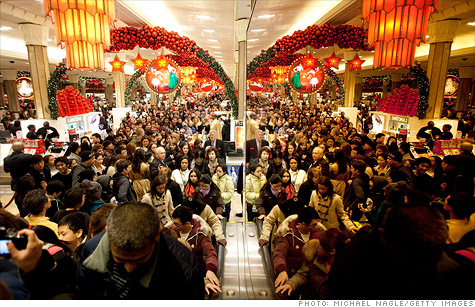
Inevitably, you hear a story about the craziness that occurs in the mad rush for savings. This year was no different. There was a story about a woman who used pepper spray on her fellow shoppers to make sure she got the product she was looking for. (But that's okay, because pepper spray is basically just a food product anyway.) It seems like the whole scene gets nuttier every year.
At the other end of the spectrum is "Buy Nothing Day". This grew out of a reaction against the excess seen on Black Friday. The point, as the name implies, is to buy nothing on a day when everyone else seems to be in a shopping frenzy. It's a day to step back and evaluate our consumerist culture and how it's destroying our society. This year it took on particular urgency, given the Occupy movement spreading throughout the country. The point was made that at the same time that protesters were getting kicked out of public spaces, people were allowed to camp out all night in front of stores just to be the first in line at 4 a.m. when the stores opened with their huge sales. The Buy Nothing movement seems to be getting more popular these days. I know a lot of people who participated just because they didn't want to get caught up in the frenzy.
[INTERJECTION: It's interesting to note that my roommate and I just had an exchange about a series of commercials advertising Christmas deals on cars that we saw while watching the Predators-Canucks game. Apparently neither of us has either given or received an automobile for Christmas because we neither love anyone enough or have someone who loves us enough to give cars as holiday gifts. How unfortunate for us when everyone else seems to be giving their loved ones new Lexus' for Christmas.]
But what if you want to do a little bit of shopping but don't want to deal with the huge crowds? What if you want to find something small and meaningful for the people in your life that you care about? Ladies and gentlemen, I present to you...Plaid Day. This is a movement I had not heard of until this year. It's a recognition of the fact that there are people who are going to go shopping the day after Thanksgiving, but the idea is to drive as much of that traffic as possible to local businesses instead of huge mall stores. Local businesses participate, although many of them do so through advertising and not by offering deep discounts. As such, my guess is that they gain business from people who already are interested in shopping locally and might want to make an extra statement on the day after Thanksgiving. I don't know if there are numbers quantifying the amount of people shopping at Plaid Friday stores instead of mall stores, or comparisons of how much money they spent, but these would be interesting to see.
Anyway, for one of my sustainability events, I decided to take advantage of Plaid Friday to go out and do some shopping. Now, I'll be honest. I mainly went out looking to buy for one person: me. I'm old-fashioned and still like to buy my music on CD rather than downloading it. However, I hadn't bought any new music for quite a while, so one of the places I ended up was Landlocked Music, where they had this display in the front window:

Between Landlocked and a later stop at TD's, I ended up with discs by Neko Case, the Decemberists, and local band Murder by Death (who will be at the Bishop Friday if you read this in time). Good haul, if you ask me. Other than buying music, I mostly did some window shopping and browsing, looking for ideas for my mom and my sister. But I got a chance to observe stores and other people shopping. There didn't appear to be huge crowds out there, but I could tell that there were a number of people who don't normally go shopping on a Friday afternoon out and getting a jump on their holiday sprees at local stores. On top of that, all of the local restaurants on the square and on Kirkwood seemed to be full, which is also good to see. All in all, it seemed like a good day for local proprietors, who took advantage of Bloomington's strong buy-local community to support their neighborhood businesses instead of the big-box stores.
Here's to more days of local shopping ahead....
Subscribe to:
Posts (Atom)